Fee Bumping or Accelerating: Which Fixes a Slow Payment?
When a payment stalls, three repairs are usually on the table: wait, rebuild the transfer with a higher fee, or push the existing one into a block. The last option is the only one that does not change the transaction, which is why it is often the cleanest. At 196 TH/s a machine earns 0.00008793 BTC a day, so an afternoon of delay costs it about $1.86, a figure worth knowing before paying anything to hurry a transfer.
Key takeaways
- Rebuilding a broadcast payment at a higher fee is a conflicting spend, and the accelerator will not touch either version.
- Acceleration keeps the original transaction intact and targets the next block the pool mines.
- Free eligibility requires 0.5 KB or less and at least 0.0001 BTC/KB, with a quota that refreshes hourly.
- At 196 TH/s, six hours of delay is worth $1.86 gross, which sets a low bar for what a hurry is worth.
Three repairs and what each one changes
Waiting changes nothing and costs only time. Rebuilding the payment changes the transaction identifier, which is exactly the problem: the network has already seen the first version, and a second version spending the same coins is a conflict. Child-pays-for-parent keeps the original and attaches a new transfer that pays a higher fee, but it requires a wallet that supports the trick and it inherits the original's low fee into the package.
Acceleration takes a fourth path. It leaves the transaction exactly as broadcast and asks the pool to include it in the next block the pool produces. Nothing about the coins, the outputs or the identifier changes, so there is no conflict to resolve and no wallet support required beyond copying the transaction hash. For a payment that is merely late rather than wrong, that is the least invasive option available.
Why a rebuilt payment creates a mess
A wallet that offers to "speed up" a transfer by re-sending it at a higher fee is usually broadcasting a replacement. Some nodes accept the replacement under rules that allow a higher-fee version to take the place of the original; others keep the first one they saw. The result is two candidate transactions and no certainty about which will confirm, which is worse than the original delay.
This is also why the accelerator rejects double-spend attempts outright. Its job is to push a specific transaction into a block, and a transaction that contradicts one already in the mempool cannot be included without invalidating the other. If you have already broadcast a replacement, decide which version you want and stop there, because submitting both guarantees that neither gets help.
What "next block" is worth
Inclusion in the next block that the pool mines is a strong promise with a soft edge. It removes competition on fee rate, so the transaction stops losing ground to better-paid ones. It does not fix the pool's block-finding luck: a pool that finds blocks less often than its share of the network suggests will sometimes take longer than expected, and no tool can change that.
Practically, that means ViaBTC TX Accelerator is most valuable when the mempool is crowded and least valuable when it is empty. In a quiet market, an ordinary low-fee transfer confirms on its own within a few blocks and paying to jump the queue buys very little. In a busy one, the same transfer can sit for hours, and the queue-jump is the difference between a payment arriving today and arriving tomorrow.
| Hashrate | BTC per hour | Gross USD per hour | Six hours of delay |
|---|---|---|---|
| 196 TH/s | 0.00000366 | $0.31 | $1.86 |
| 784 TH/s | 0.00001466 | $1.24 | $7.45 |
| 1.96 PH/s | 0.00003664 | $3.10 | $18.62 |
Run the comparison the other way and it becomes a budgeting rule. If the payment is worth less than six hours of your mining credit, waiting is the rational choice unless a deadline says otherwise. If it is worth much more, the hurry is about the payment and not about the mining at all, and the decision should be made on the payment's terms.
Reading the clock honestly
Most people overestimate how long a transaction has been stuck, because they start counting from the moment they pressed send rather than from the moment it reached the mempool. A transfer that took two minutes to propagate has not been waiting for those two minutes in any meaningful sense. Check the timestamp on the explorer entry, not the timestamp on your message to the recipient.
The other common error is counting confirmations as if they were minutes. A confirmation is a block, and blocks arrive on average every ten minutes but with wide variation. Six confirmations is an average of an hour, not a fixed hour. When a recipient insists on six, the wait is a statistical property of the network, and no accelerator shortens the confirmation count itself; it only gets the first one included sooner.
Write the transaction identifier down before you start fixing anything. Every repair route needs it, whether you are submitting to a queue or checking which version of a payment the recipient is looking at, and it is the one piece of information that cannot be reconstructed from a screenshot of a wallet balance. Paste it into a note with the amount and the recipient's address, and the rest of the conversation becomes factual.
When the recipient is another exchange
Exchanges publish their own confirmation requirement, and it is often higher than a shop's. The accelerator can shorten the wait for the first confirmation, which is the part it controls, but it cannot make the remaining confirmations arrive faster. A deposit credited after three confirmations will still need the other two blocks.
Read the deposit page before broadcasting rather than after. If the requirement is six confirmations and the fee is at the low end, the honest expectation is an hour or more, and no amount of queue-jumping changes the count. Knowing that in advance turns a frustrating wait into a planned one.
A fee rate is fixed at broadcast
The rate is set when the transaction leaves the wallet. If the mempool clears ten minutes later, the transfer keeps its original rate and confirms because there is less competition, not because it became cheaper. If the mempool fills instead, the same rate looks worse with every block. Neither outcome was decided at the moment you started watching.
This is the argument for choosing a rate you are willing to live with for an hour, rather than the lowest one that might work. The difference is usually a few cents on a small payment and a great deal of attention on a large one.
Worked example
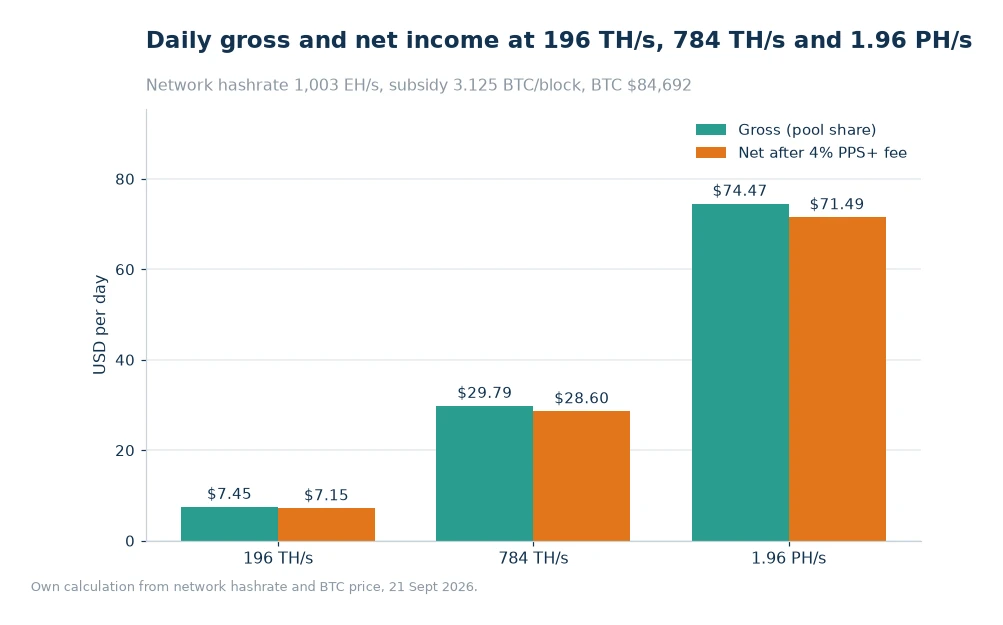
Start from the network and work down to the hourly cost of a delay, using the three hashrates in the chart.
- Take one terahash: 450 BTC divided by 1.003 billion TH/s gives 0.00000044865 BTC a day.
- At 196 TH/s: 196 × 0.00000044865 = 0.00008793 BTC a day, which is $7.45 at $84,692.
- Net after the listed 4% on the block-reward component: 7.45 × 0.96 = $7.15.
- An hour is a twenty-fourth of that: 0.00000366 BTC, $0.31 gross; multiply by six for $1.86.
- 784 TH/s gives 0.00035173 BTC a day, $29.79 gross, and $1.24 for each hour.
- 1.96 PH/s, ten times 196 TH/s: 0.00087927 BTC a day, $74.47 gross, $3.10 an hour and $18.62 across six hours.
Frequently asked questions
Does accelerating a transaction change its fee?
No. The transaction keeps the fee it was broadcast with; the payment for the service is separate and is settled in BTC, BCH or LTC from your account.
Can I accelerate a transaction I already replaced?
Only one version can be helped. A replacement conflicts with the original, and a conflicting spend is rejected, so choose the version you want before submitting anything.
How long does an accelerated transaction take to confirm?
It is included in the next block the pool mines, so the wait depends on when that block is found rather than on the fee rate or the size of the mempool.
Choose the cheapest repair that works
Write the three options in order of intrusiveness: wait, accelerate, then rebuild. The first costs time, the second costs a fee and leaves the transaction untouched, and the third creates a conflict that may take longer to resolve than the original delay. For most late payments, the middle option is the one that ends the problem without creating a new one.
Before submitting, check the two free-tier conditions and the current listed rates, so you know whether the queue will accept the transaction or whether the paid route is the only one left. Submissions are accepted around the clock, and the pool state page shows how the pool's hashrate is moving, a useful guide to how soon the next block might arrive.
Sources: the accelerator guide and fee schedule[1]. Snapshot of 21 Sept 2026: 1,003 EH/s network hashrate, 132.76 T difficulty, 3.125 BTC per block, 144 blocks a day, BTC $84,692. Published 24 Oct 2026; block intervals vary.