Planning Notes for Hospitality FF&E Procurement Planning
Hospitality FF&E procurement spans many product categories that must arrive in the right configuration, sequence, and condition for installation. A room-by-room schedule links design intent to supplier quotes, samples, approvals, manufacturing, delivery, and handover. Planning those dependencies early helps avoid late substitutions and costly site storage.
Key takeaways
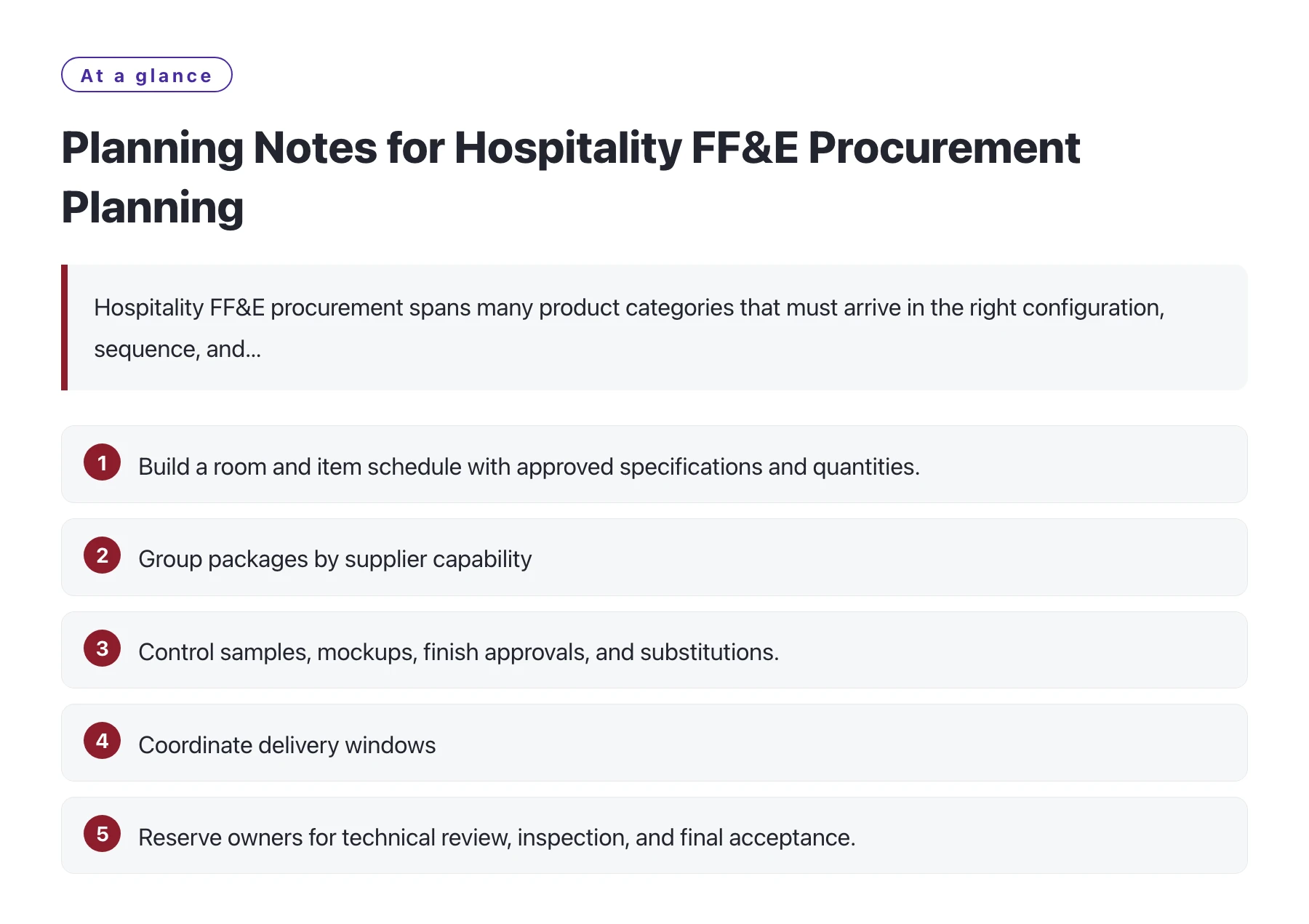
- Build a room and item schedule with approved specifications and quantities.
- Group packages by supplier capability, lead time, and installation sequence.
- Control samples, mockups, finish approvals, and substitutions.
- Coordinate delivery windows, access, storage, assembly, and damage reporting.
- Reserve owners for technical review, inspection, and final acceptance.
Keep project requirements, supplier commitments, installation plans, and handover records connected.
1. Create the room-by-room procurement schedule
List guestrooms, lobby, restaurant, meeting rooms, back-of-house, and outdoor areas. For each, record item code, description, finish, dimensions, quantity, room count, approved drawing, sample status, and required-on-site date. Identify long-lead items and design dependencies.
Keep furniture, lighting, textiles, equipment, hardware, and accessories clearly separated while preserving the room context. A room set may include many suppliers, so the schedule should identify interfaces such as power, mounting, clearance, and matching finishes.
Include ownership for quantity reconciliation and room changes. If room types or keys differ, identify substitutions and extra items explicitly. This schedule becomes the common reference for quotations, mockups, packing marks, and site receipt, so maintain revision history as design decisions are made.
2. Define package strategy and supplier capability
Decide whether to award by category, room package, or coordinated package based on product expertise, production capability, quality risk, and logistics. Identify which supplier owns assembly, integration, labeling, and coordination between components.
Check the actual producing site and subcontractors for complex items. Ask how suppliers manage approved drawings, finishes, capacity, samples, and change notices. Keep scope boundaries clear so two suppliers do not both assume the other supplies a required accessory.
3. Coordinate specification and design approval
Issue current drawings, finish schedules, performance requirements, installation details, packaging, and destination rules. Record mandatory attributes and acceptable alternatives. Assign design, engineering, operations, and compliance owners to each approval.
Use a submittal register with due dates and status. Ensure supplier drawings show dimensions, connections, access panels, fixings, and service clearances where relevant. Approval should identify the exact revision and should not imply acceptance of unrelated safety or regulatory evidence.
4. Plan samples and mockups
Select samples that represent the quoted configuration and finish. For items affecting guest experience or fit, plan full-size mockups or room prototypes. Record lighting conditions, adjacent materials, installation, control settings, and who attended review.
Separate visual approval from functional, structural, or regulatory acceptance. If a supplier proposes a material or component change, identify which approvals and tests must be repeated. Protect retained samples and label them with model, revision, and date.
5. Integrate lead times and approval gates
Build backward from room installation and opening dates. Include design freeze, quote award, sample, mockup, technical review, production start, inspection, shipping, customs, receiving, assembly, and punch-list. Add realistic buffers for rework and document closure.
Set gates that prevent production from advancing while critical approvals remain open. Confirm material readiness and capacity with evidence. If a long-lead item slips, assess substitutions through the same design, quality, and compliance review rather than allowing an informal replacement.
6. Compare commercial and delivery assumptions
Normalize quantities, unit, finish, options, tooling, packaging, assembly, spare parts, warranty, payment, lead time, freight, and exclusions. For each package, identify order minimums, split shipments, storage fees, and price validity.
Name the selected delivery rule and exact place in the contract. ICC Incoterms® rules help clarify specific seller and buyer delivery tasks, costs, and risks; separately agree installation, unloading, internal movement, and site acceptance. [2]
7. Plan access, storage, and installation
Check loading docks, lift dimensions, corridor turns, floor loading, temporary storage, security, waste removal, installation crew, and work-hour restrictions. Coordinate delivery sequence so bulky items do not block the site or suffer damage while waiting.
Label packages by room, floor, item, and installation sequence. Protect finished surfaces, track shortages, and establish a damage-reporting window. If goods require acclimatization, assembly, or specialist commissioning, include it in the schedule and responsibility matrix.
8. Set quality and handover controls
Define inspection points, approved reference, defect categories, functional checks, document set, spare parts, manuals, warranty start, and final acceptance criteria. Assign who checks at factory, arrival, installation, and room handover.
ISO 9001:2026 defines quality management system requirements; supplier system evidence can inform process review but does not approve the project’s furniture or equipment. Check actual items and records against the contract. [1]
Record defects found at each stage and confirm who owns correction. A product accepted at the factory may still be damaged in transit or installed incorrectly, so preserve separate evidence for factory, receiving, and room handover.
9. Manage package status and changes
Maintain one package tracker with supplier, current revision, quoted amount, sample approval, production stage, inspection, shipping, site receipt, open issues, and owner. Review exceptions weekly with project and operations teams.
Buyers using hotel furniture and equipment sourcing can agree what coordination, supplier communication, inspections, and shipment planning are included. Keep design, compliance, commercial, and site acceptance decisions with named stakeholders.
Sources
Frequently asked questions
When should FF&E procurement planning begin?
Start while room schedules, specifications, and long-lead items are being developed so samples, approvals, production, and delivery can be coordinated.
Why use a room-by-room schedule?
It connects item quantities and approvals to installation sequence, room readiness, delivery labels, and final handover.
Can one supplier replace several package vendors?
Only after confirming capability, scope ownership, quality controls, interfaces, schedule, and evidence for every included product.
What should a mockup approval record include?
Identify product revisions, finishes, installation conditions, attendees, findings, unresolved items, and the specific scope approved.