Perfume Production Lead Times: Which Stage Really Eats the Calendar
The longest part of a perfume project is almost never the blending. Formula development, packaging approval and regulatory paperwork consume far more calendar time, and two of those three depend on decisions the brand controls. Buyers who plan backwards from a launch date — listing every stage that must finish before delivery, then checking which of them can overlap — finish on time more often than buyers who count forward from a purchase order.
Key takeaways
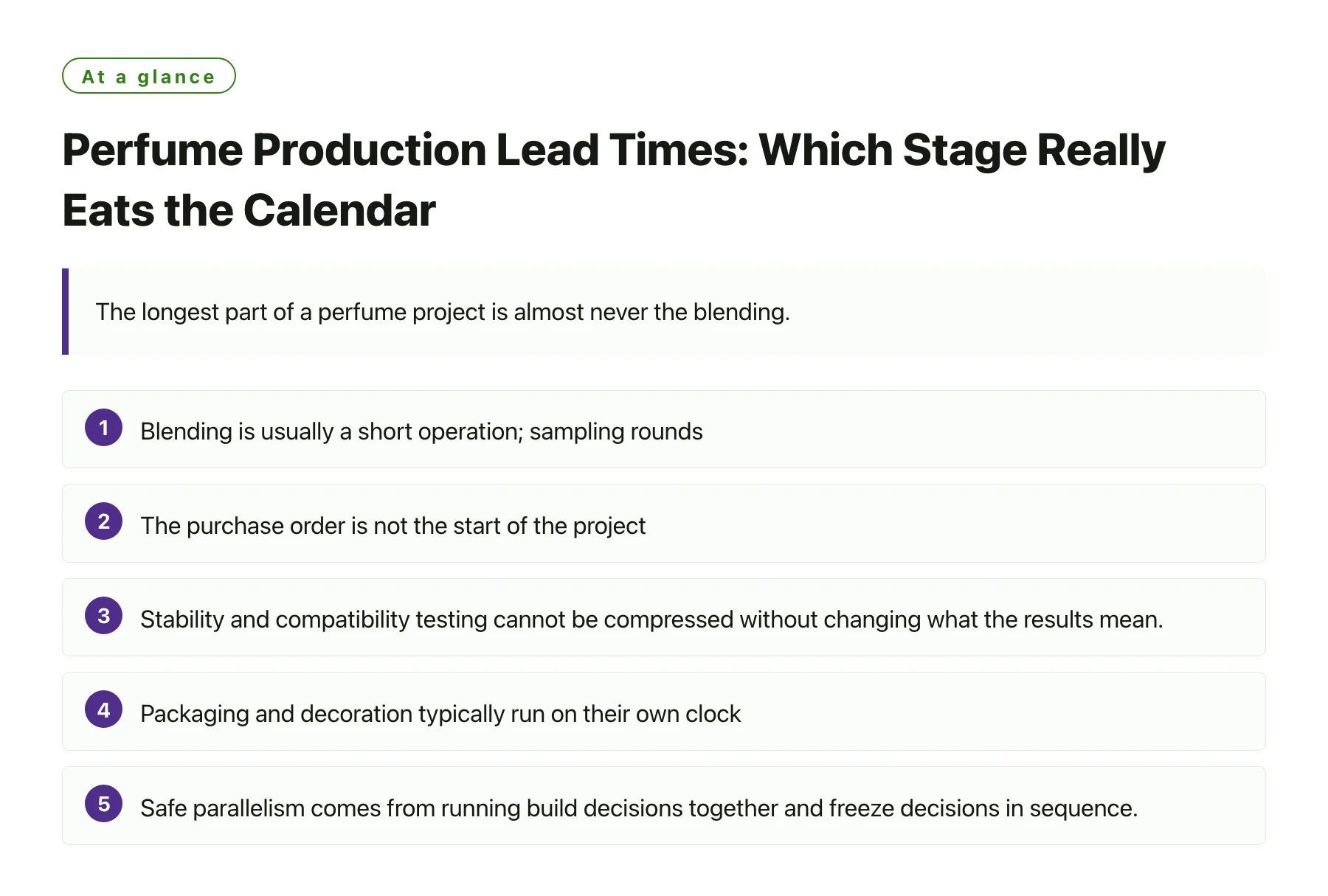
- Blending is usually a short operation; sampling rounds, packaging approval and documentation consume most of the schedule.
- The purchase order is not the start of the project, so a lead time quoted from PO to delivery understates the real calendar.
- Stability and compatibility testing cannot be compressed without changing what the results mean.
- Packaging and decoration typically run on their own clock, and it is the component nobody ordered that slips the date.
- Safe parallelism comes from running build decisions together and freeze decisions in sequence.
Ask five suppliers for a lead time and you will receive five answers that all sound reasonable and none of which are comparable. One is quoting filling only, another is quoting from approved formula, a third is quoting from receipt of packaging, and the longest is quoting from the day you first sent an email.
The confusion is structural rather than dishonest. A perfume project is a chain of steps with different owners, and each supplier quotes the part of the chain it controls. The way to get a usable number is to build the schedule yourself, stage by stage, and then ask each supplier to confirm only the stages it owns.
What follows is that stage list, what tends to hold each stage up, and where a schedule can legitimately be compressed.
The stages, in the order they arrive
- Brief and feasibilityThe brand states format, market, volume band and price ceiling; the supplier answers whether it can make that product and what it would need to see.
- Formula development and samplingA perfumer builds one or more directions from the brief and the brand evaluates them on skin, which normally takes more than one round.
- Stability and compatibility testingThe juice is checked against its container, its seals and time, and this stage runs on elapsed weeks rather than on effort.
- Packaging, tooling and decorationComponents are confirmed or ordered, tooling is cut if the shape is bespoke, and decoration trials happen before the bulk run.
- Artwork, labelling and market paperworkIngredient and allergen declarations, safety documentation and market notifications are prepared and approved by the people who sign them.
- Bulk production and macerationThe compound is blended and allowed to rest so the mixture settles before it is judged or filled.
- Filling, quality release and dispatchThe batch is filled, checked against the approved reference, packed and handed to freight.
Where the calendar actually goes
Once the stages are written down, the surprise is how little of the schedule is chemistry. The technical work is concentrated and predictable; the variability sits in decisions, approvals and the arrival of physical components.
That matters because the two categories respond to different management. Technical work needs a competent supplier. Schedule risk needs a person on the brand side whose job is to chase answers, and it needs to be a named person rather than a shared inbox.
Sampling rounds, not blending
Blending a bulk batch is a short operation. Finding the formula in the first place is not, because each round produces a sample that must rest, be assessed and be answered. Three rounds with slow feedback cost more time than three rounds with fast feedback.
The single most effective schedule habit is to evaluate samples on a fixed day and return one consolidated set of comments. Comments that arrive piecemeal create a fourth round by themselves.
Testing that refuses to be hurried
Stability and compatibility testing exists to find out what happens over time, and its duration is part of the method. Shortening it does not accelerate the answer, it removes it. Where a launch is genuinely tight, the realistic move is to start testing on a near-final formula and later confirm the frozen one.
The same logic applies to the wider sector: packaging and manufacturing practice that affects launch timing is followed closely by industry titles such as HAPPI, which cover personal care production and packaging [1].
Approvals that wait on people
Every stage ends with a signature, and signatures queue behind holidays, travel and internal review. A project with five sequential approvals has five chances to lose a week to an unanswered email.
Decide who signs what before the project starts. A single approver for scent, a single approver for packaging and a clear escalation path removes most of the avoidable delay.
What holds each stage up, and what can run beside it
| Stage | Usual cause of delay | Safe to run in parallel with | Risky to run in parallel with |
|---|---|---|---|
| Formula development | Slow or contradictory sample feedback | Packaging sourcing and artwork drafting | Bulk material purchasing before the formula is frozen |
| Stability and compatibility testing | Late start because the pack was not final | Label design, market documentation, freight planning | Nothing that assumes a passing result |
| Packaging and tooling | Bespoke moulds, third-party caps and pumps, decoration trials | Formula refinement, artwork, compliance paperwork | Filling dates promised before components land |
| Artwork and market paperwork | Waiting on the final formula and the final container | Print preparation and freight booking | Printing before the declaration list is signed off |
| Bulk production and filling | Component shortage, or a batch that needs rework | Dispatch planning and customs paperwork | Booking transport before quality release |
The third and fourth columns are the useful part of this table. Almost every stage can overlap with something, and almost every stage has one neighbour it must not overlap with. Write those two lists for your own project and the schedule becomes something you can defend rather than something you hope for.
Compressing a schedule without buying risk
There are honest ways to shorten a launch and dishonest ones. The honest ones move information earlier; the dishonest ones remove checks and call the result speed.
Two questions separate them. Does this change what we will know before we commit money, and does it change what we can still change after we commit it?
Move decisions earlier, not stages
The largest realistic saving comes from deciding the format, the market and the price ceiling in the first week instead of the fourth. Those three answers unlock the formulator, the packaging search and the compliance route at the same time.
Where packaging supply is a known constraint, it also helps to know which steps a manufacturer performs in house rather than subcontracted; the process description on the Xuelei official website sets that out, which makes it easier to see where the handovers are.
Freeze in the right order
Freeze the container before the print, the formula before the declaration list, and the declaration list before the printer starts. Reversing any of those pairs converts a cheap change into an expensive one.
A useful discipline is to keep a one-page freeze log with the date each item was locked and who locked it. When a question arises three months later, the log answers it in a minute.
Keep a buffer where it does the most good
Buffers belong before dispatch rather than inside testing. A few held days at the end absorb small surprises from any stage without renegotiating anything, while a shortened stability window quietly transfers the risk to the market.
If the buffer has to shrink, shrink it deliberately and record what was accepted. Most schedule failures are not caused by a lack of time; they are caused by a risk that was taken silently and then forgotten.
The most common planning mistake is treating the purchase order as the start of the project. By the time a PO is raised, the formula, the pack and the paperwork should already be resolved, because everything expensive happens before that point. If a supplier quotes a production lead time that begins at PO and your launch date is measured from that same PO, the two calendars are describing different things and only one of them includes sampling, testing and tooling. Build the list yourself, mark the owner of each stage, and ask each supplier to confirm only the stages it controls. It takes an afternoon and saves the argument later. Manufacturers that publish their process, as Xuelei in Guangzhou does, make that list easier to assemble.
Sources
- HAPPI — Household & Personal Products Industry —— An industry magazine covering the household and personal care market, including fragrance, formulation and packaging.
Frequently asked questions
How long does perfume production take from start to delivery?
It depends far more on packaging and approvals than on the juice. Bulk blending and filling are comparatively short, while sampling rounds, stability testing, tooling and artwork each add time. Build the schedule stage by stage from the brief, and ask suppliers to confirm only the stages they own.
Why do different suppliers quote such different lead times?
Because they are measuring from different starting points. One counts from an approved formula, another from receipt of packaging, another from the purchase order. Convert every quote to the same reference point before comparing, otherwise the numbers cannot be ranked.
Can stability testing be shortened to hit a launch date?
It can be started earlier on a near-final formula, which is a legitimate form of compression, but shortening the test itself removes the information it was supposed to produce. The decision about whether that risk is acceptable belongs to the brand, and it should be recorded rather than assumed.
What should a brand freeze first in a perfume project?
The container, then the formula, then the declaration list, then the print. Each of those freezes unlocks the next stage, and reversing the order turns cheap changes into expensive ones. Keep a dated freeze log so the sequence can be audited later.
Which stage most often causes a missed launch date?
Packaging or an approval, not production. A bespoke mould, a decorated component arriving late, or an unanswered artwork sign-off accounts for more slippage than filling capacity. That is also why these are the stages worth reviewing weekly rather than monthly.