Framing Expectations Before a Long Storyline
Long storylines fail for planning reasons more often than for writing reasons. Before the first scene, settle three things — the shape, the endpoint and the exit — and give the arc a budget in sessions rather than a target in weeks.

Key takeaways
- Budget the arc in sessions. Six sessions is 1.5 hours at 15 minutes each, 3.0 hours at 30 and 6.0 hours at 60.
- Choose one shape — a goal to reach or a situation to live in — before the first message, because the two end differently.
- Set a stall rule. Two flat sessions without new detail is the point to park an arc, not to push through it.
- Long arcs depend on recall, so test it in session one rather than discovering the limit in session six.
Plan an arc in sessions, not in scenes
Scenes are a useful unit for writing and a poor one for planning, because a scene's length depends entirely on how the conversation goes. Sessions are the unit you actually control: they are already your habit, and their length is a decision you make before you start.
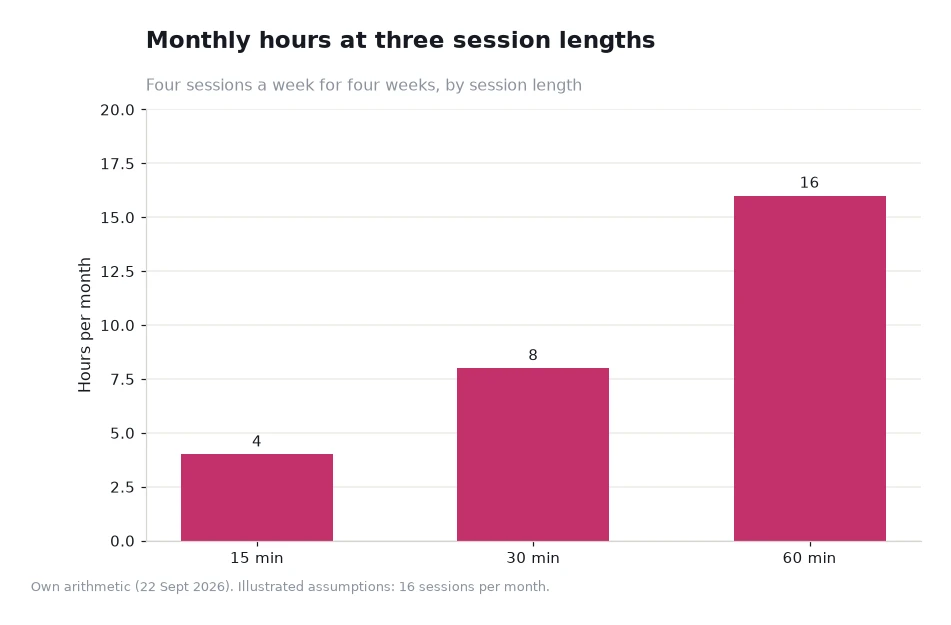
Six sessions is a workable arc for most readers. At a quarter of an hour per session that is 1.5 hours in total; at half an hour it is 3.0 hours; at a full hour it is 6.0 hours. Set against a month of sixteen visits, the half-hour version is 3.0 of 8.0 hours, which leaves five hours for everything else.
That last figure is the point of planning at all. A storyline with no session budget competes with the rest of the month for the same hours, and the competition is invisible until the month is over and the arc has quietly consumed most of it.
What to settle before the first message
Shape comes first. A goal-driven arc has something to reach, which gives you a natural ending and a reason for scenes to build. A situation-driven arc has somewhere to live, which gives you durability and no obvious stopping point. Both work; mixing them without deciding produces an arc that neither ends nor settles.
Endpoint comes second, and it can be approximate. Knowing roughly where an arc finishes stops the drift that turns a good six-session story into an indefinite one, and it makes the mid-point review meaningful rather than decorative.
The exit comes third and matters most. Decide in advance what counts as a stall: two consecutive sessions that add no new detail is a common and honest rule. When the rule triggers, park the arc rather than ending it; a parked storyline can resume in a month, and it costs nothing in the meantime.
A fourth decision makes the other three easier to keep: what you will do at the review point. If the arc has produced nothing new by session three, the sensible options are to change the character's goal, to shorten the plan from six sessions to four, or to park it outright. Settling that in advance removes the temptation to keep a storyline alive simply because of the hours already inside it.
| Decision | Why it matters | Workable default |
|---|---|---|
| Arc length in sessions | Sets the budget before the budget is spent | Six sessions |
| Shape | Decides whether the arc can end | A goal to reach, not a state to occupy |
| Endpoint | Stops indefinite drift | An outline agreed in session one |
| Stall rule | Prevents dead months | Two flat sessions, then park it |
| Recall check | Long arcs live or die on memory | Verify an early detail returns by session one |
| Review point | Makes judgement possible | After session three, before the arc doubles |
Worked example: one arc, three clock speeds
Keep the arc at six sessions and let the session length move. Six visits of 15 minutes each total 1.5 hours, which is about 38% of a four-hour month built on the same short sessions. Six visits of half an hour total 3.0 hours, about 38% of an eight-hour month. Six visits of an hour total 6.0 hours, and again about 38% of a sixteen-hour month.
The consistency is the useful part. An arc's share of your time does not change when your sessions get longer, so the decision to run a six-session storyline is a decision about a fixed proportion of the month rather than about a variable number of hours.
It also tells you what a second arc costs. Two six-session arcs at half an hour each take 6.0 of the 8.0 monthly hours and leave two hours for everything else, which is usually the point at which a reader discovers why running two arcs at once feels like work.
There is a cheaper way to find out whether an arc deserves half the month. Commit to the first three sessions, hold the review, and only then decide about the second three. A four-session arc that ends well costs 2.0 hours in the half-hour pattern instead of 3.0, and leaves six hours of the month untouched for a character you already trust.
Reading the category's own claims first
Long arcs depend on one feature more than any other, and it is the one worth verifying before you commit: recall. The platform describes characters that remember your preferences and adapt over time, and a storyline is the setting where that claim either shows up or does not.
The porn ai chat page states the claim in its own words alongside customizable characters and privacy, and it answers the terminology question in the same place by treating AI Porn Chat and Porn Chat AI as one category. Read it once, then test the recall claim in a single session rather than taking it on trust for six.
Two resources keep a long arc supplied. Crushon's NSFW AI trends board is where a second character comes from when an arc ends, and the AI chat blog covers prompting and pacing, which is what keeps a six-session arc from turning into six repetitions of the same exchange.
Short arcs also suit characters you are still assessing. Committing six sessions to a card you have never tested is a bet on recall, and recall is precisely the property a first session is best placed to measure — which is why the smallest version of the plan is also the safest one.
Frequently asked questions
How long should a storyline be?
Six sessions is a workable default, which is 3.0 hours at half an hour a session and about 38% of an eight-hour month.
When should I stop rather than continue?
When two consecutive sessions add nothing new. Park the arc at that point; a parked storyline can resume later, while a forced one tends to end badly and early.
What if the character forgets earlier events?
Test recall in session one with a detail you can check later. If it does not return by the end of a session, keep the storyline short rather than planning a long one.
Plan six sessions, then decide
Give an arc a shape, an approximate ending and a stall rule before it starts, then review it after session three. That is enough structure to keep a storyline moving without turning a pastime into a project, and it leaves the rest of the month intact if the arc does not work.
Data and sources: the recall claim, product wording and terminology published on CrushOn.AI[1], read 22 Sept 2026. The six-session arc, the session-length hours and the review points are illustrative assumptions, not platform data. This piece is written for an adult readership of 18 and over.